Most people treat pricing like simple maths. But in reality, pricing is perception, and perception can be shaped.
The number you choose matters, but how you present that number matters even more. Pricing taps into cognitive shortcuts, biases, and heuristics that people use to make decisions quickly. Understanding these psychological effects lets you frame your prices so they feel more compelling, without changing their actual value.
This post breaks down some of the most powerful behavioural principles behind the psychology of pricing, along with supporting research.
1. Anchoring: The First Number Sets the Frame
The anchoring effect is one of the most reliable findings in behavioural economics. The first number people see acts as a mental “anchor” that influences how all subsequent prices are perceived.
In Tversky & Kahneman’s classic 1974 experiments, participants spun a “random” wheel of fortune. Those who landed on higher numbers consistently gave higher estimates for unrelated factual questions, like the number of African nations in the UN. The anchor stuck, even though it was meaningless.
In pricing, the first price people encounter shapes their perception of value. Showing a higher “original” price, premium tier, or even placing expensive items next to standard ones can make your core offer feel like a better deal.
Dan Ariely famously demonstrated this with The Economist’s subscription pricing. Participants were given three options:
- Web-only subscription: $59
- Print-only subscription: $125
- Web + Print subscription: $125
Almost nobody chose print-only, but its presence doubled the number of people who chose the $125 combo over the $59 web-only. The print-only tier acted as a decoy anchor, making the combo feel like great value (Ariely, 2008).
2. Decoy Effect: Shaping Perceived Value Through Comparisons
The decoy effect occurs when adding a third, strategically structured option makes another option look more appealing. Huber, Payne, and Puto (1982) demonstrated that introducing an asymmetrically dominated “decoy” increases the likelihood of choosing the dominating option.
For example, imagine offering:
- Basic Plan – £49
- Pro Plan – £89
- Premium Plan – £120 (with only slightly more features than Pro)
Here, Premium acts as the decoy. It makes Pro look like the smart, high-value choice, not because Pro changed, but because Premium reframes it by comparison.
3. Charm Pricing: Why £49 Feels Cheaper Than £50
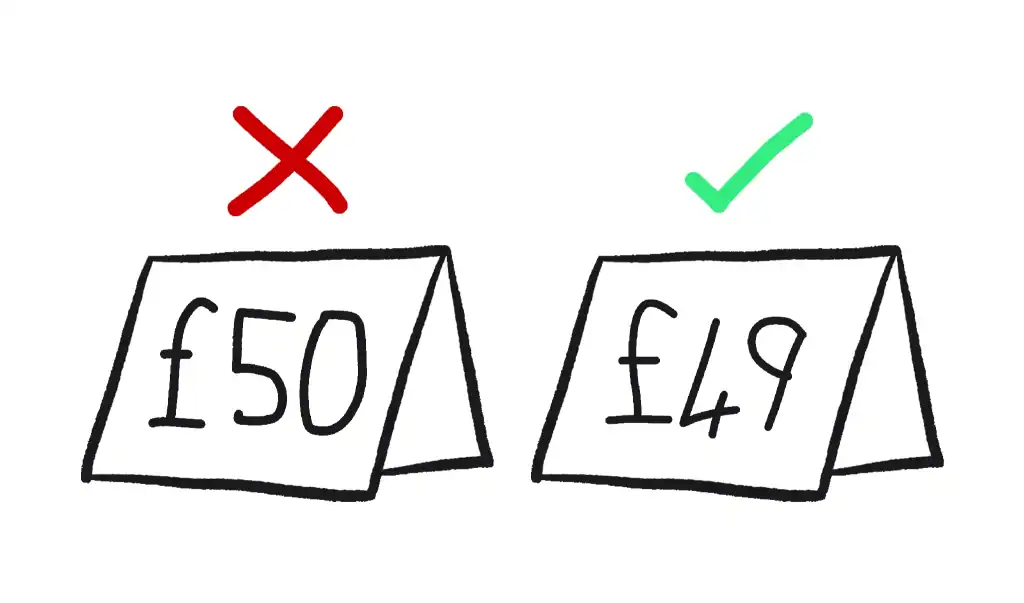
Pricing that ends in .99 or .95, often called “charm pricing,” consistently performs better than round numbers in many contexts.
Thomas and Morwitz (2005) showed that left-digit effects play a significant role: people encode numbers left-to-right, so they perceive £2.99 as closer to £2 than £3.
Schindler and Kibarian (1996) ran a mail-order catalogue test and found that prices ending in .99 outperformed rounded prices by 8%, holding all else equal.
This isn’t universal; luxury goods, for example, sometimes use round numbers to convey prestige, but for most eCommerce contexts, charm pricing leverages fast, intuitive processing to make prices feel lower.
4. Partitioned vs Bundled Pricing: How Presentation Affects Perception
How you present prices can affect demand, even when the total cost is the same.
Morwitz, Greenleaf, and Johnson (1998) found that partitioned pricing (e.g., “£25 + £5 shipping”) can increase demand compared to all-inclusive pricing, especially when the surcharge feels justified. Customers mentally focus on the base price, underweighting the add-on.
However, this effect is context-dependent. Partitioning works well for shipping or optional extras but can backfire if the surcharge feels sneaky or unexpected.
Conversely, bundled pricing can reduce the pain of paying by merging multiple decisions into one, which is why subscription models and bundles often boost conversion rates.
5. The Pain of Paying: Timing and Method Matter
Prelec and Loewenstein (1998) coined the phrase “the pain of paying” to describe how parting with money activates the brain’s pain centres.
Some payment methods reduce this pain. Credit cards, for example, decouple the timing of payment from the moment of consumption, making spending feel less painful than paying cash. That’s why one-click checkout, saved payment details, and buy-now-pay-later options can all increase conversion rates, they lower the salience of payment at the decision moment.
This principle also applies to framing payment frequency. Annual pricing presented monthly (“£300/year — just £25/month”) can feel less daunting, even though the total is identical. The anchor shifts from the total to the digestible monthly figure.
6. Framing and Relative Value
People evaluate prices relatively, not absolutely. Kahneman and Tversky (1981) showed that framing effects can completely change decision outcomes even when underlying values stay the same.
A £50 discount feels very different depending on the reference point. Saving £50 on a £100 jacket feels huge; saving £50 on a £2,000 sofa often feels negligible, despite being the same amount.
Ecommerce brands can use framing strategically:
- Show savings as a percentage on lower-priced items to maximise perceived value.
- Show savings as absolute amounts on higher-priced products to make the discount feel meaningful.
- Present higher-priced bundles first to set the anchor before introducing core offers.
Next Steps
Pricing isn’t about trickery. It’s about understanding how people perceive value, then structuring your offers so they resonate intuitively.
If this post opened your eyes to what’s possible, check out my weekly newsletter. It dives deeper into anchoring, decoys, charm pricing, bundling strategies, and practical experiments you can run in your own store to increase revenue, without changing your products.
📚 References
- Tversky, A. & Kahneman, D. “Judgment under Uncertainty: Heuristics and Biases.” Science (1974).
- Ariely, D. Predictably Irrational (2008).
- Huber, J., Payne, J., & Puto, C. “Adding Asymmetrically Dominated Alternatives: Violations of Regularity and the Similarity Hypothesis.” Journal of Consumer Research (1982).
- Thomas, M. & Morwitz, V. “Penny Wise and Pound Foolish: The Left-Digit Effect in Price Cognition.” Journal of Consumer Research (2005).
- Schindler, R. & Kibarian, T. “Increased Consumer Sales Response through Use of 99-Ending Prices.” Journal of Retailing (1996).
- Morwitz, V., Greenleaf, E., & Johnson, E. “Divide and Prosper: Consumers’ Reactions to Partitioned Prices.” Journal of Marketing Research (1998).
- Prelec, D. & Loewenstein, G. “The Red and the Black: Mental Accounting of Savings and Debt.” Marketing Science (1998).
- Kahneman, D. & Tversky, A. “The Framing of Decisions and the Psychology of Choice.” Science (1981).